From doubt to discovery: charting new territories in epigenetics with Dr. Bercin Cenik
“A scientific finding is meaningful regardless of how it’s received. You’ve added something new to our collective knowledge.”
Bercin Cenik, a Research Assistant Professor working with Dr. Ali Shilatifard at Northwestern University‘s Department of Biochemistry and Molecular Genetics, is developing technologies that are tackling previously intractable questions in chromatin biology. Throughout her career journey from developmental biology to epigenetics, she’s discovered that breakthrough science requires not just technical innovation, but the persistence to overcome scepticism and the vision to see connections across disciplines. Her persistence has paid off, with TurboCas now being adopted by labs around the world.
From developmental biology to epigenetics and beyond: Bercin’s leap of faith
“I’m classically trained as a molecular biologist,” Bercin explains, reflecting on her beginnings in Dr. Eric Olson‘s lab at UT Southwestern. Those early days focused on transcription and developmental biology, where Bercin discovered a skeletal muscle-specific gene in mice that, when deleted, caused severe congenital muscle disease. “Not long after, mutations in the same gene were identified in human patients,” she notes, highlighting how this fundamental research quickly demonstrated clinical relevance.
This period of what Bercin describes as “focused, hypothesis-driven research” coincided with the genomics revolution. As sequencing costs dropped, transcriptomics accelerated, and tools like CRISPR/Cas9 transformed biological research, Bercin recognised a paradigm shift in the field.
“It became clear that the future would be about understanding regulatory networks and patterns, not just individual genes,” she reflects. This realisation prompted a pivotal career move to Dr. Ali Shilatifard’s lab at Northwestern, where she transitioned to discovery-based research and genomics. “I had already switched fields – from developmental biology to epigenetics – for my postdoc. That kind of leap is becoming less common; the pressure to produce quickly in a short postdoc window often makes switching specialties feel risky. But I wanted to learn new techniques and pursue discovery-based research, and I was lucky to have a mentor who supported that vision.”
TurboCas: overcoming barriers in epigenetics research
The crown jewel of this transition has been the development of TurboCas, a genetic tool that allows researchers to label proteins bound to specific genomic loci. This innovation addresses a fundamental challenge in epigenetics research.
“Chromatin-binding proteins are essential to gene regulation, yet many existing methods to study them capture only static interactions or are limited by technical constraints,” Bercin explains. “TurboCas helps overcome those barriers.”
The system works by using a catalytically dead Cas9 (dCas9) to guide the system to a specific locus of interest using CRISPR single guide RNA. Once positioned, a miniTurbo biotin ligase tags nearby proteins with biotin, enabling scientists to purify and identify them through mass spectrometry.
But developing TurboCas wasn’t without significant hurdles. “Bringing TurboCas to where it is now took time – nearly six years from the first experiments to the publication,” Bercin reveals. “Locus-specific protein labelling has been a long-standing goal in chromatin biology, but it’s a huge technical challenge; You’re trying to isolate proteins from just two copies of a gene in a sea of three billion base pairs. The signal-to-noise ratio is not ideal.”
The journey faced a significant setback when a reviewer questioned not just her results, but the entire conceptual framework. “They believed the method wasn’t just unproven, but conceptually flawed,” Bercin recalls, admitting that this criticism “planted real doubt” despite her experience handling critical feedback.
The breakthrough came unexpectedly when a fellow postdoc independently reproduced her results using a completely different approach. “At that point, we realised we were onto something real,” Bercin recalls. This validation led her to withdraw the manuscript from review, add the complementary data, and aim for a higher-impact publication – a gamble that ultimately paid off.
Crossing disciplinary boundaries
Bercin’s path to proteomics wasn’t exactly a predefined trajectory. “I actually didn’t have any formal training in proteomics,” she admits. “I came from a molecular biology and genetics background, where protein-level analyses were usually the endpoint of a project.”
This perspective shifted during her postdoctoral work, when Dr. Ali Shilatifard was her mentor. “I was at the departmental retreat, and Dr. Alice Ting gave a talk on BioID and TurboID,” Bercin recalls. “It was the first time I saw proteomics not as a black box, but as a flexible, intuitive tool you could adapt to your own biological question.”
This interdisciplinary approach has become central to her research philosophy. “There’s value in being a well-rounded scientist, not just a domain-specific expert,” she reflects. “I had to become a systems thinker, balancing biological insight with tool development, experimental rigour, and conceptual clarity.”
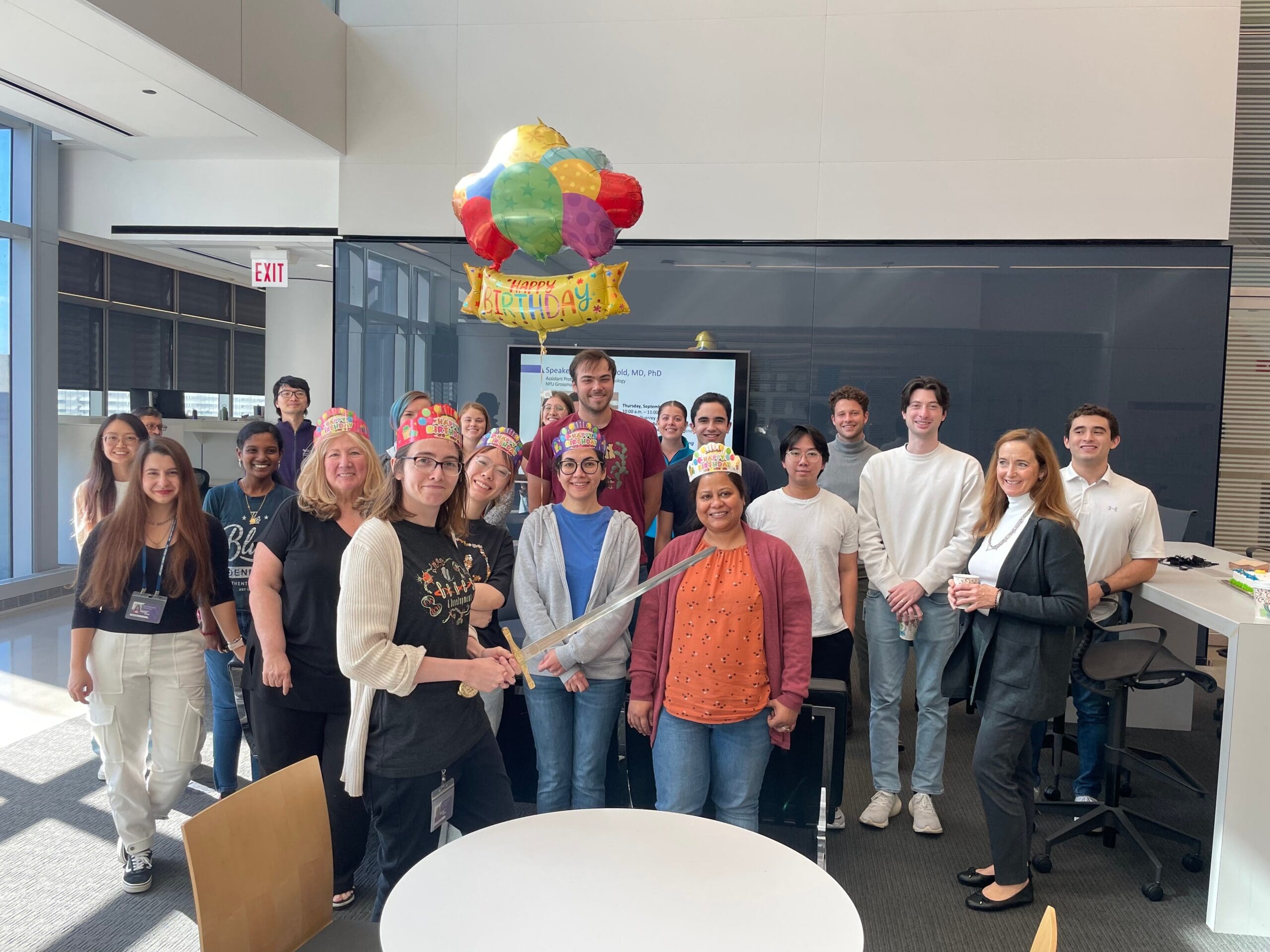
Bercin getting ready to cut a cake in celebration of the TurboCas paper getting accepted, along with her and three colleagues’ birthdays. The giant sword is for cutting the cake – a lab tradition.
The technical aspects of proteomics work are supported by strong collaborations with core facilities. “The Thermo Fisher Center for Multiplexed Proteomics at Harvard for our TMT-based TurboCas experiments and Northwestern’s proteomics core facility for label-free work on the complementary RNA Polymerase II and Cyclin T1 immunoprecipitations,” Bercin explains. High-quality chromatography is essential to both workflows. “The Aurora Series columns used at Northwestern have been a reliable part of our process,” she notes. “The consistency and reproducibility of the data have made downstream analysis more straightforward, and the overall performance has helped support our evolving proteomics applications.”
From bench to research leader
As her career evolved, so too has Bercin’s role in the lab. “Right now, I lead a small team – just two technicians. While it’s been a really rewarding experience, it’s also taught me a lot,” she shares.
The transition from bench scientist to research leader brought unexpected lessons. “After more than a decade at the bench, I thought I had a good handle on how to work efficiently. But once you take on a leadership role, you quickly realise you’re no longer just managing your own time. You’re shaping someone else’s learning curve, pace, and priorities too.”
One particularly meaningful moment came when team members began taking initiative without prompting. “That’s when it clicked: nobody comes into the lab preloaded with your enthusiasm or experience. Part of the job is helping them find their own way into the science, helping them care about the work in their own voice, not just echoing yours. When that happens, it’s incredibly fulfilling.”
Pushing boundaries and embracing challenges
Bercin’s current focus is on advancing TurboCas beyond its initial applications. “Now that the initial technology paper is out, the tool is available to everyone. When other labs test it and ask new questions with it, you learn where the tool shines and where it needs refining. Honestly, that’s the best way to improve a method,” she explains.
Her team is particularly interested in applying TurboCas to genomic regions that have traditionally been difficult to study. “We’re excited about using TurboCas to study genomic regions that are notoriously hard to interrogate, like repetitive elements or regions buried in constitutively silent chromatin,” Bercin says. “These areas are tough to study using traditional techniques like ChIP-seq, which often can’t get reliable signals there.”
This next phase of research is expected to be even more challenging than the original proof-of-concept work. “We had known regulators to serve as sanity checks. This time, we’re going in with fewer assumptions, which, to me, makes it even more exciting,” she notes.
You can read TurboCas’ initial technology paper here.
A look back and a look ahead
Reflecting on her career journey, Bercin muses: “I think I’d tell myself that science rewards perseverance more than anything else. There’s always going to be someone you’re trying to convince: a reviewer, a funding agency, a colleague – that what you’ve found matters.”
Bercin looks beyond publication metrics when reviewing scientific discovery: “A scientific finding is meaningful regardless of how it’s received. Whether it’s published in a high-impact journal or not, whether it gets funded or not – that doesn’t change the fact that you’ve added something new to our collective knowledge.”
This mindset shapes Bercin’s approach to mentorship and collaboration. “I’m really excited to see more researchers take up tools like TurboCas and make them their own,” she emphasises. “Science moves forward when ideas are shared, challenged, and reimagined.”
As for what lies ahead, Bercin remains committed to building bridges between genomics and proteomics. “That kind of integration between genomics and proteomics is where I think the field is headed,” she predicts, embodying the cross-disciplinary thinking that has defined her career so far.
Would you like to be featured in an upcoming Community Newsletter? Email us at communications@ionoptickscopy.com and tell us a bit about yourself and your research.

