From Blocks to Breakthroughs: How Moe Haines is Breathing New Life into Archived Tissue Samples
“In proteomics, you generate data that lives on. Today’s snapshot might answer tomorrow’s questions.”
Moe Haines, a Senior Research Associate II at the Broad Institute of MIT and Harvard’s Proteomics Platform, is transforming decades-old tissue samples into rich sources of medical knowledge. With a background in biochemistry and molecular biology, and after experimenting with various jobs in industry, he has found his current niche in proteomics. Now, he’s actively working to better understand cancer and rare diseases.
Finding a Path Through Chemistry and Biology
Moe’s journey began with a fascination for the intersection of chemistry and biology. “My main interest in biochemistry comes from how it would explain complex biology through the chemistry involved, rather than just having to look at the biology on its own. It made remembering the biology much easier, and more manageable,” he explains.
It wasn’t until after his undergraduate degree, involving nearly a year of independent research, that he got to experience the full power of proteomics. During his undergraduate years, Moe recalls being largely limited to traditional research methods. He would see advertisements for new instruments but they were not accessible to him. This set the stage for his later fascination with higher-throughput techniques that would expand the possibilities of scientific research, allowing researchers to get “a global, more sophisticated picture” instead of being confined to narrow, single-point analyses.
“My journey with different roles in industry assured my interest in proteins. Transitioning to drug discovery made me appreciate proteomics beyond the academic setting. However, higher throughput instrumentation and advances in the field really reinforced it for me,” Moe reflects. Getting to experience multiple jobs was just what Moe needed to discover his interests: “Experimenting around sparks your curiosity and helps you figure out what you actually enjoy,” he explains.
Beyond Genomics: The Value of Protein-Level Analysis
Proteomics offers unique insights that genomic analyses alone can’t provide. As Moe explains, “When we talk proteomics, you’re getting a clearer picture compared to genomics because you’re one step closer to your question. In genomics, you’re still working with sequence blueprint or cellular code, and it doesn’t always tell the full story in real time.”
The scale of information that is accessible through proteomics is staggering. “From 20,000 human genes, you end up with about a million proteoforms when you account for post-translational modifications (PTMs) and different isoforms. Mass spectrometry unlocks endless possibilities in the proteomics realm.”
While the technology is what originally sparked Moe’s interest in proteomics, it’s the endless applications that now fascinate him. Protein-level analysis is especially valuable for understanding disease mechanisms and drug interactions. “In a pharmaceutical setting, proteomics often contributes to the validation of early drug candidates. Protein expression data support our understanding of the candidate’s mechanism of action, while target-engagement assays reveal the drug’s affinity to off-target proteins, for better selectivity and reduced risk of toxicity.”
Unlocking Secrets from Preserved Tissues
One of Moe’s most fascinating current research areas involves extracting proteomic information from formalin-fixed, paraffin-embedded (FFPE) tissue samples. These samples, stored at room temperature for decades through chemical preservation, represent a vast untapped resource for medical research.
“I think it’s fascinating that we’re able to recover information from tissue that’s been kept at room temperature for decades,” Moe says. “There are plenty of available blocks in repositories from different tumour types to various diseases. Now, we access them to look for any driver proteins across different individuals.”
The traditional method of preserving tissue samples in formalin has inadvertently created a treasure trove of biological information. “Formalin hardens, and chemically speaking, stabilises the tissue in a paraffin block”, explains Moe. “The cool thing is the metadata that is linked to each patient—vital status, medications, disease progression and outcome, and so on—can be correlated with meaningful protein expression patterns.”
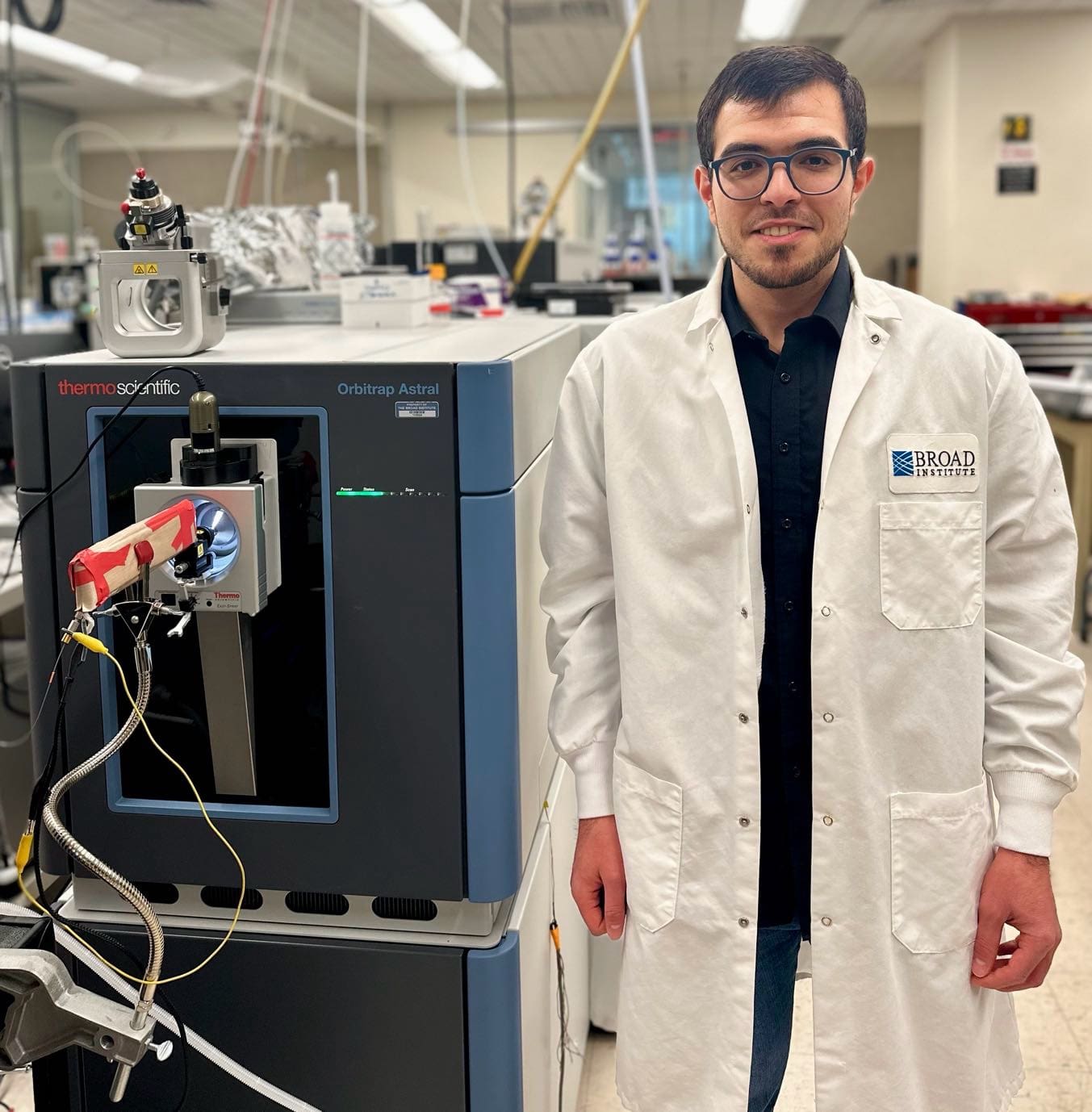
Working with these samples presents unique challenges, which Moe and his team are addressing through innovative approaches. “Traditionally, you’d slice the block, transfer it to a slide, and then manually extract the tissue—washing and dipping it several times to remove wax and retrieve proteins,” he says. “What we’ve done is evaluate more of a plate-based FFPE processing approach. You’re doing all the cleanup and wax removal within the same plate, which speeds up the process.” This makes the workflow more compatible with higher-throughput studies and reduces the hands-on time individual researchers need to spend preparing samples.
For this specialised work with lower-input samples, Moe relies on high-sensitivity equipment. “In the PTM space, I would definitely use IonOpticks columns, because of their robustness in handling lower inputs” he notes. “We get sharp, highly resolved peaks from lower input samples. Their compatibility with higher LC pressures allows for faster analyses and syncs nicely with faster instrumentation.”
Learn more about Moe’s work using formalin here.
Beyond the Surface: Proteomics’ Potential to Transform Treatment
Beyond improving methodologies, Moe’s research could transform cancer treatment: “We’re focused on a specific cancer type,” he explains, “examining how treatment decisions influenced cancer progression and outcome.” The research addresses a critical problem: cancer recurrence, which in some cancers affects approximately 50% of patients following initial, “curative” treatment.
“By applying advanced proteomic technologies,” Moe notes, “we are getting closer to better decision-making when it comes to therapeutic decisions, based on each patient’s proteogenomic landscape. The goal is to understand how we can reduce the impact of recurrence and potentially improve survival outcomes.”
His research extends beyond cancer, exploring broader applications such as rare diseases. “For example, in Mendelian disorders—rare genetic diseases caused in mutations in a single gene. Genomics can offer a starting point for proteomics to investigate how those mutations influence downstream signalling pathways and overall cellular function.”
This cutting-edge research represents just one facet of the collaborative approach that defines modern proteomics. Working within the Proteomics group at the Broad Institute, Haines benefits from an environment where innovation in sample processing, data generation, and analysis technologies has become the norm. The team’s intensive collaborations extend throughout the United States and beyond, addressing fundamental questions across biology, chemistry, and clinical sciences. When reflecting on his scientific development, Haines is quick to acknowledge those who’ve shaped his path: “I particularly want to call out Dr. Michael Gillette, Dr. Shankha Satpathy and Dr. Steven Carr, who continue to provide invaluable guidance in my proteomics journey.”
The Future of Proteomics
Moe has witnessed tremendous growth in the field during his career. New instrumentation and methods have dramatically increased the speed and depth of protein analysis. “Newer instrumentation such as the timsTOF, or Orbitrap Astral, allowed for more efficient methods, where you’re able to see almost 10,000-11,000 proteins from single samples, in run times as short as 20 minutes.”
This technological leap is partly due to improved equipment like high-pressure compatible columns. “Actually, the first time we identified 10,000 proteins in a single run was using an IonOpticks column,” Moe recalls. “It was a new instrument, and the vendor was using an IonOpticks column on it—it was the best of both worlds.”
These and other advancements allow researchers to overcome previous bottlenecks in their workflows. Looking ahead, Moe sees artificial intelligence and increased computational power as key drivers for the field’s continued evolution. “What will be interesting is how AI will get even more integrated into what we do,” he predicts. “The more we train models—and we have so much data we can train the models on—the more we might explore the dark matter of our MS/MS spectra.” Just like how formalin has helped Moe uncover insights from old tissue, AI could do the same for data: “Data is expensive to store, so we might as well put it to good use.”
The computational demands of proteomics are substantial, and Moe is excited about the advances in this area. “Everybody’s hyping NVIDIA right now—and for good reason. I grew up thinking of NVIDIA as something you’d only use for video games… I can’t wait for more native GPU-based MS/MS searching, this will tremendously speed things up.”
While Moe has experienced challenges in his career, he remains enthusiastic about the opportunities in proteomics. The field’s ability to generate vast amounts of data means that even unexpected results can lead to future discoveries. “That’s what’s cool about the field. You generate data. Just because you’re not using it now, doesn’t mean you won’t use it anymore,” Moe explains. “You can always come back to it later for a different analysis… You’re taking a snapshot, and you save it. It’s not a one-time experiment.”
With the proteomics market expected to double by the end of the decade, researchers like Moe Haines are turning complex data into real-world insights. “It’s not just generating and reporting big numbers,” Moe says. “We’re putting that into meaningful conclusions.” Whether he’s extracting protein information from decades-old samples or exploring how protein modifications might unlock new medical understanding, he’s showing how technical expertise can translate into potential breakthroughs.
Would you like to be featured in an upcoming Community Newsletter? Email us at communications@ionoptickscopy.com and tell us a bit about yourself and your research.

