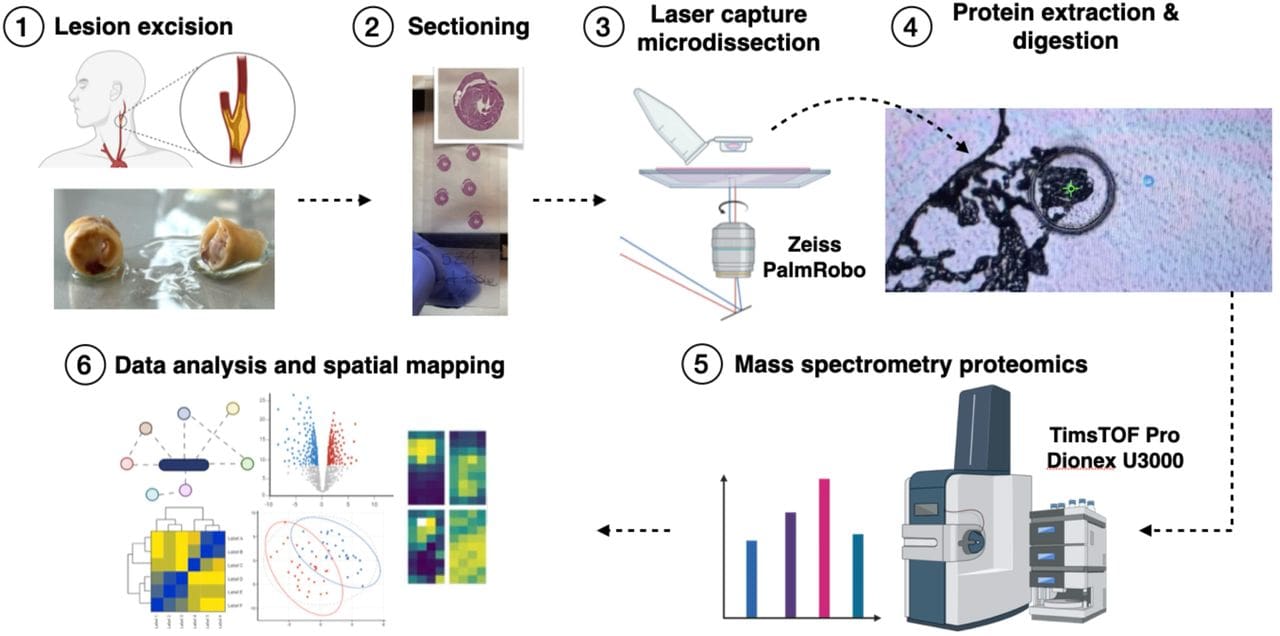
General workflow and overview. From Jokumsen et al., 2025. “Spatial proteomics of the human atherosclerotic microenvironment reveals heterogeneity in intra-plaque proteomes and extracellular matrix remodeling“, bioRxiv 2025.06.13.659602; doi: https://doi.org/10.1101/2025.06.13.659602. Licensed under the terms of the Creative Commons CC-BY-ND 4.0 license.
Cardiovascular diseases remain the leading cause of death globally, with atherosclerotic plaques prone to rupture causing major complications. While previous studies have analysed entire plaques using bulk proteomic approaches, this masks critical spatial differences within plaques. The molecular patterns underlying different plaque regions and their association with rupture vulnerability remained unexplored at the protein level.
Jokumsen et al. aimed to develop a high-throughput spatial proteomics workflow to map protein distributions across distinct microenvironments within atherosclerotic plaques. Their approach combined laser-capture microdissection with liquid chromatography–mass spectrometry (LC-MS), using a timsTOF Pro mass spectrometer equipped with a CaptiveSpray ion source and coupled to an UltiMate 3000 LC system. Peptides were separated on an IonOpticks Aurora Rapid® 5 cm ×150 μm CSI C18 UHPLC column with 15-minute gradients.
This exploratory study achieved significant improvements in protein identification, detecting 648 proteins from microdissected regions as small as 50,000 μm² using data-dependent acquisition, and up to 1,047 proteins using data-independent acquisition (DIA-PASEF). Analysis of human carotid plaques revealed pronounced proteomic heterogeneity, with only 33% of proteins detected across all sampled regions. The researchers from the Gamon lab demonstrated that shoulder regions showed elevated inflammatory markers (CD36, MMP12) and tissue degradation proteins (CTSB, TNC), while necrotic cores contained predominantly plasma proteins, consistent with intra-plaque haemorrhage.
This spatial proteomics approach offers unprecedented insights into the mechanisms underlying plaque vulnerability and represents a powerful tool for identifying therapeutic targets to prevent plaque rupture and subsequent cardiovascular events.
Publication
bioRxiv
Authors
Kathrine J Jokumsen, Lasse G Lorentzen, Karin Yeung, Timothy A. Resch, Jonas P Eiberg, Michael J Davies, & Luke F Gamon;
Title

