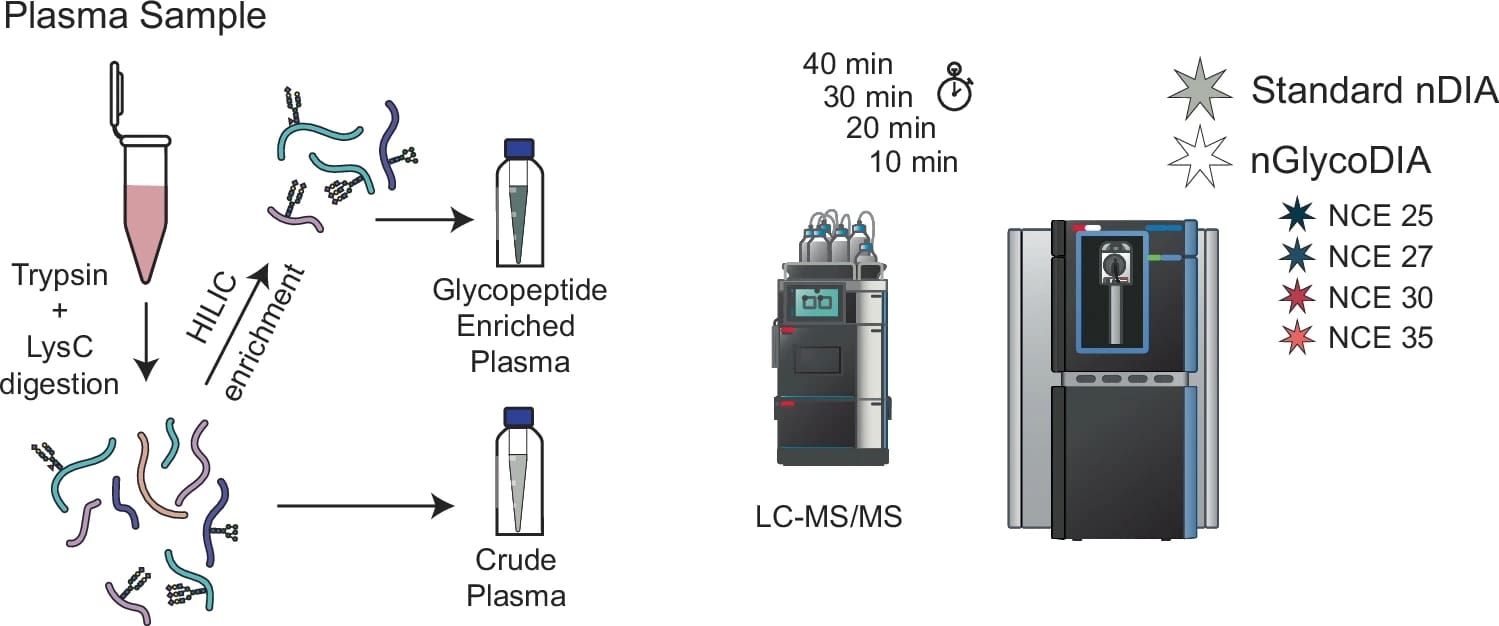
Evaluation of data-independent acquisition (DIA) of plasma glycopeptides. From Jager et al., 2025. “In-depth plasma N-glycoproteome profiling using narrow-window data-independent acquisition on the Orbitrap Astral mass spectrometer“, Nat Commun 16, 2497 (2025); doi: https://doi.org/10.1038/s41467-025-57916-1. Licensed under the terms of the Creative Commons CC-BY 4.0 license.
Protein glycosylation is a critical post-translational modification that affects both biological functions and physicochemical properties of plasma proteins. Comprehensive characterisation of the plasma N-glycoproteome is crucial for understanding disease mechanisms but remains highly challenging due to glycan microheterogeneity, low ionisation efficiency, complex fragmentation behaviour, and the wide dynamic range of plasma proteins.
In a groundbreaking study published in Nature Communications, Jager et al. introduce nGlycoDIA , a novel narrow-window data-independent acquisition approach for plasma glycoproteomics. With the convergence of several key enabling technologies- the Orbitrap Astral’s high-speed asymmetric track lossless (Astral) analyser, capable of 200 Hz MS/MS scanning, nGlycoDIA’s 4 m/z isolation windows, the team used an IonOpticks Aurora Ultimate™ 25×75 XT C18 UHPLC column interfaced with a Vanquish Neo UHPLC system. This setup was designed to leverage the speed of the Astral analyser with optimised collision energies and gradient lengths with the aim of enhancing glycopeptide detection.
This approach identified more than 3,000 unique glycosylated peptide-spectrum matches per injection replicate using 40-minute LC gradients, covering 181 glycoproteins and 436 glycosites spanning seven orders of magnitude in plasma concentration. Notably, shorter 10-minute gradients proved most efficient, maximising unique glycoPSM identifications per minute without compromising depth. Compared to data-dependent acquisition on the same instrument, nGlycoDIA increased glycopeptide identifications by 50%.
The detection of several low-abundance glycosylated cytokines not typically observed in standard plasma proteomics suggests that glycopeptide enrichment may enhance detection of these proteins These findings align with proteomics trends toward high-sensitivity, high-speed analyses, promising advancements in personalised medicine and biomarker discovery. Future work could refine GlycoDIA for quantitative analysis, potentially revolutionising diagnostics by targeting glycan structures linked to diseases like cancer or neurodegeneration.
This work establishes a foundation for high-throughput plasma glycoproteomics, enabling identification of diverse glycoproteins in as little as 10 minutes per sample, a timescale that could facilitate clinical screening and biomedical research, disease diagnosis, and inform treatment strategies.
Publication
Nature Communications
Authors
Shelley Jager, Martin Zeller, Anna Pashkova, Douwe Schulte, Eugen Damoc, Karli R. Reiding, Alexander A. Makarov & Albert J. R. Heck;
Title