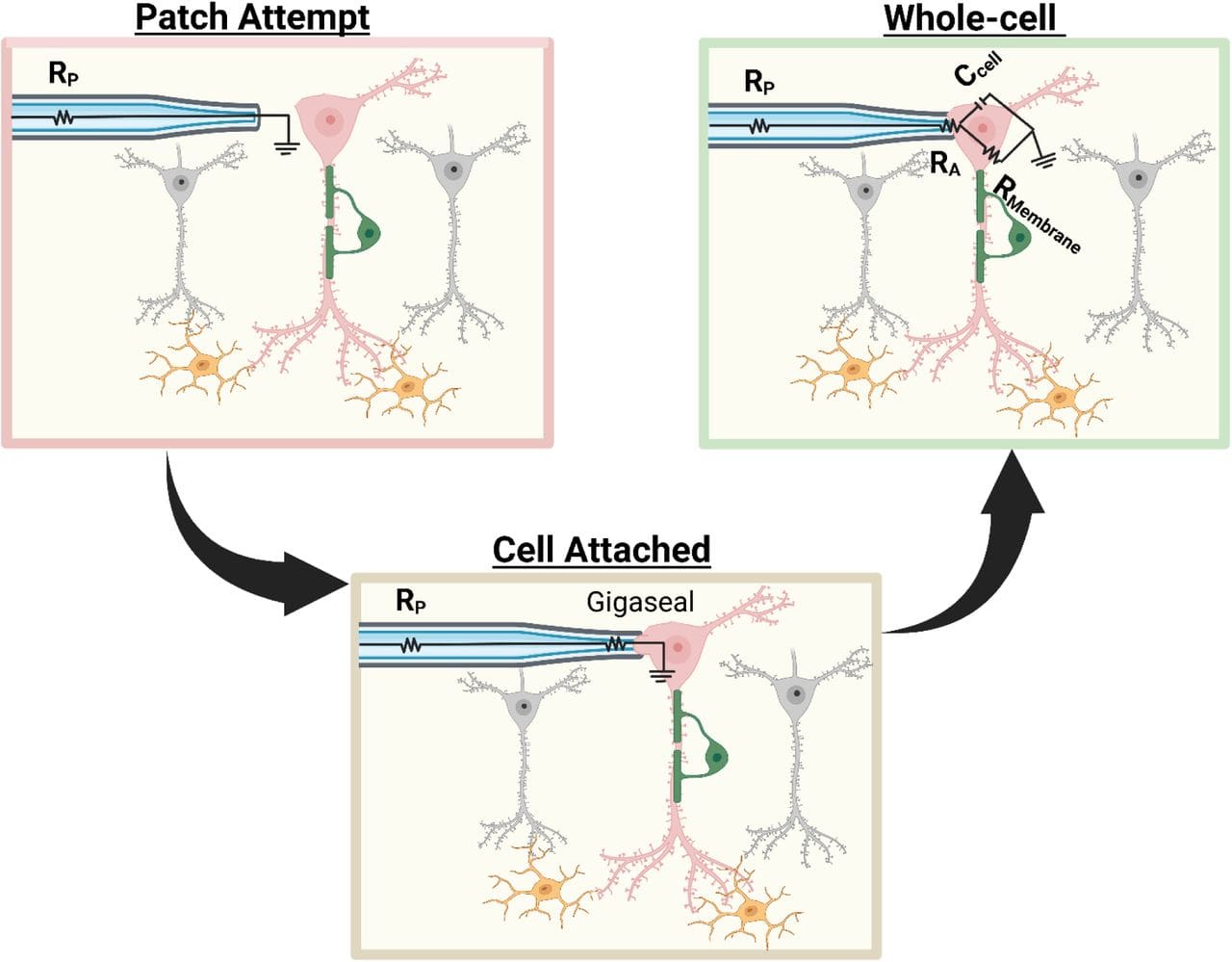
Schematic of the patch-clamp process. From Rodriguez et al., 2025. “Patch-Clamp Single-Cell Proteomics in Acute Brain Slices: A Framework for Recording, Retrieval, and Interpretation“, bioRxiv (2025): 2025-09.; doi: https://doi.org/10.1101/2025.09.15.675920. Licensed under the terms of the Creative Commons CC-BY 4.0 license.
Single-cell proteomics combined with electrophysiology represents a powerful approach for understanding neuronal function, but technical challenges have limited its application in brain tissue. Previous patch-seq studies successfully linked RNA profiles to neuronal activity, however extending this to protein analysis faces significant obstacles including poor recovery of membrane proteins like ion channels and GPCRs that directly control electrical properties.
Rodriguez et al. aimed to develop a comprehensive framework for patch-clamp single-cell proteomics (patch-SCP) that could reliably detect transmembrane proteins while maintaining electrophysiological recordings during neuron retrieval from acute brain slices. The researchers from the Yates lab developed a “shotgun” approach analysing all retrieved neurons regardless of recording quality, using gigaseal preservation as a quantitative bridge between proteomics and electrophysiology.
The experimental workflow employed a Vanquish Neo coupled to an IonOpticks Aurora Ultimate™ 25×75 C18 UHPLC column, connected to an Orbitrap Astral operating in data-independent acquisition mode. Samples were processed using trypsin digestion in DDM surfactant.
This exploratory study achieved detection of over 1,500 – 2,300 proteins per neuron, successfully identifying key ion channel subunits (SCN2A, GABRA1, CACNA2D1) and GPCRs across all samples. The researchers demonstrated that soma size (measured as capacitance) directly correlates with protein recovery, while spike integrity during retrieval predicts recovery of synaptic proteins. The framework revealed that retrieval quality exists along quantitative and qualitative dimensions, with both affecting biological insight.
This advancement enables future studies linking neuronal electrical properties to their molecular basis in intact brain circuits, potentially advancing understanding of neurological disorders and drug targets.
Publication
bioRxiv
Authors
Larry Rodriguez, Jolene Diedrich, Aline M. A. Martins, Le Sun, Blake Tsu, Stefanie Kairs, Roman Vlkolinsky, Christopher A. Barnes, Marisa Roberto, & John R. Yates 3rd;
Title

