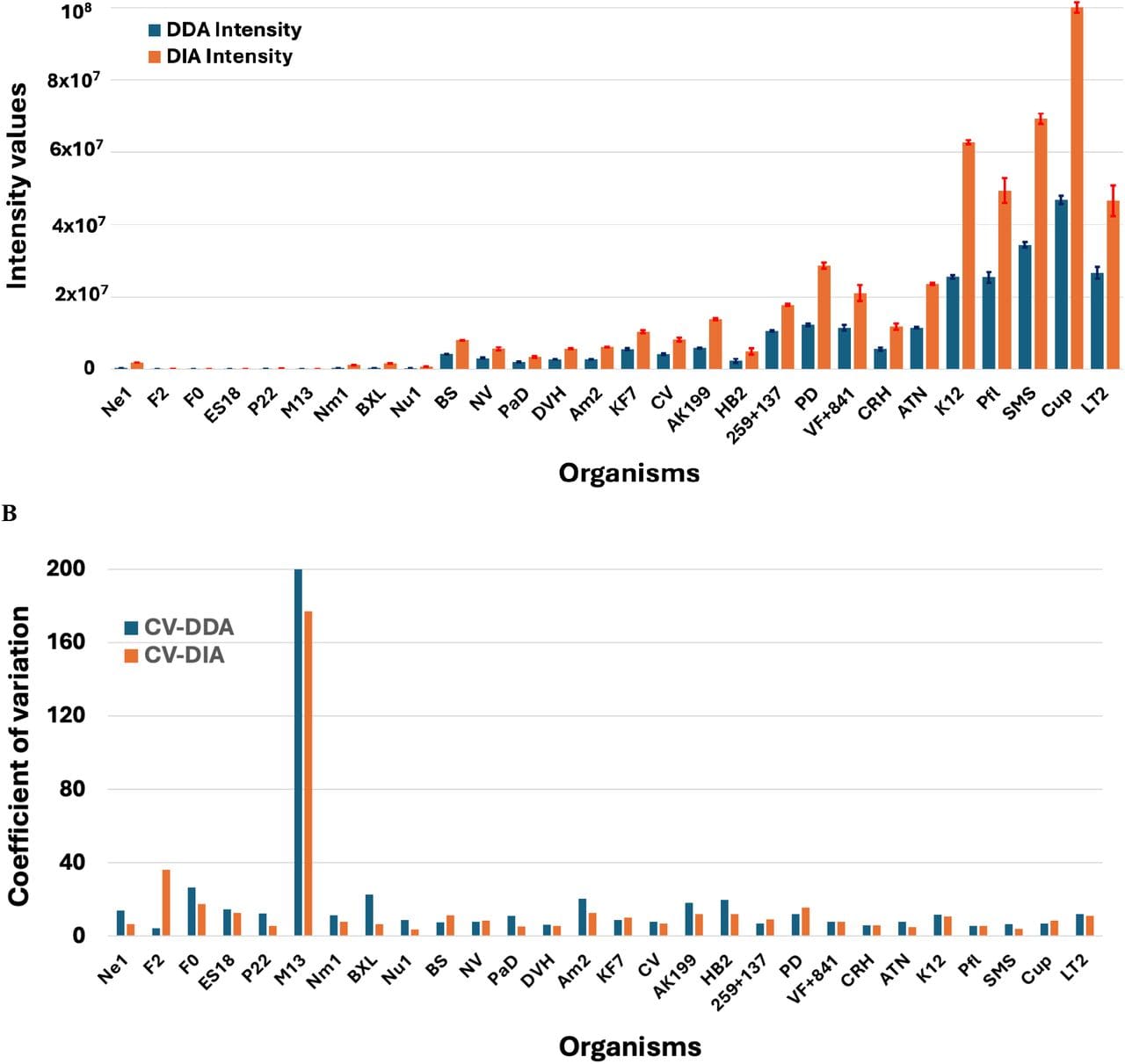
Comparison of ddaPASEF and diaPASEF intensity measurements by organism. From Shrestha et al. “Evaluation of Parallel Accumulation-Serial Fragmentation methods for metaproteomics using a model microbiome..“, bioRxiv (2025): 2025-08. https://doi.org/10.1101/2025.08.13.670166. Public domain.
Metaproteomics, the study of proteins from microbial communities, faces significant challenges in detecting low-abundance proteins and achieving reproducible quantification across complex samples. Traditional data-dependent acquisition (DDA) methods often miss important microbial proteins, limiting our understanding of microbiome function. Shrestha et al. aimed to evaluate whether diaPASEF (data-independent acquisition with Parallel Accumulation-Serial Fragmentation) could overcome these limitations compared to ddaPASEF methods.
The experimental approach utilised a well-characterised mock community containing 28 species across all domains of life with a 400-fold dynamic range in organism abundance. The researchers from the Jagtap lab employed a nanoElute connected to a timsTOF HT via CaptiveSpray source, using an 80-120 minute gradient on an Aurora Ultimate™ 25×75 CSI C18 UHPLC column.
This quantitative study revealed substantial improvements with diaPASEF: 168% more precursors, 155% more peptides, and 66% more proteins were detected compared to ddaPASEF. Additionally, diaPASEF demonstrated superior reproducibility, with 22 out of 28 organisms showing lower coefficient of variation values between replicates.
The enhanced protein detection capability of diaPASEF enables deeper functional analysis of microbial communities, particularly benefiting clinical metaproteomics where microbial content represents a smaller proportion of total proteins. This advancement provides researchers with improved tools for understanding microbiome-host interactions and metabolic processes, potentially leading to better diagnostic and therapeutic approaches for microbiome-related diseases.
Publication
bioRxiv
Authors
Ruben Shrestha, Andrew T. Rajczewski, Katherine Do, Matthew Willets, Manuel Kleiner, Timothy J. Griffin, & Pratik D. Jagtap;
Title

