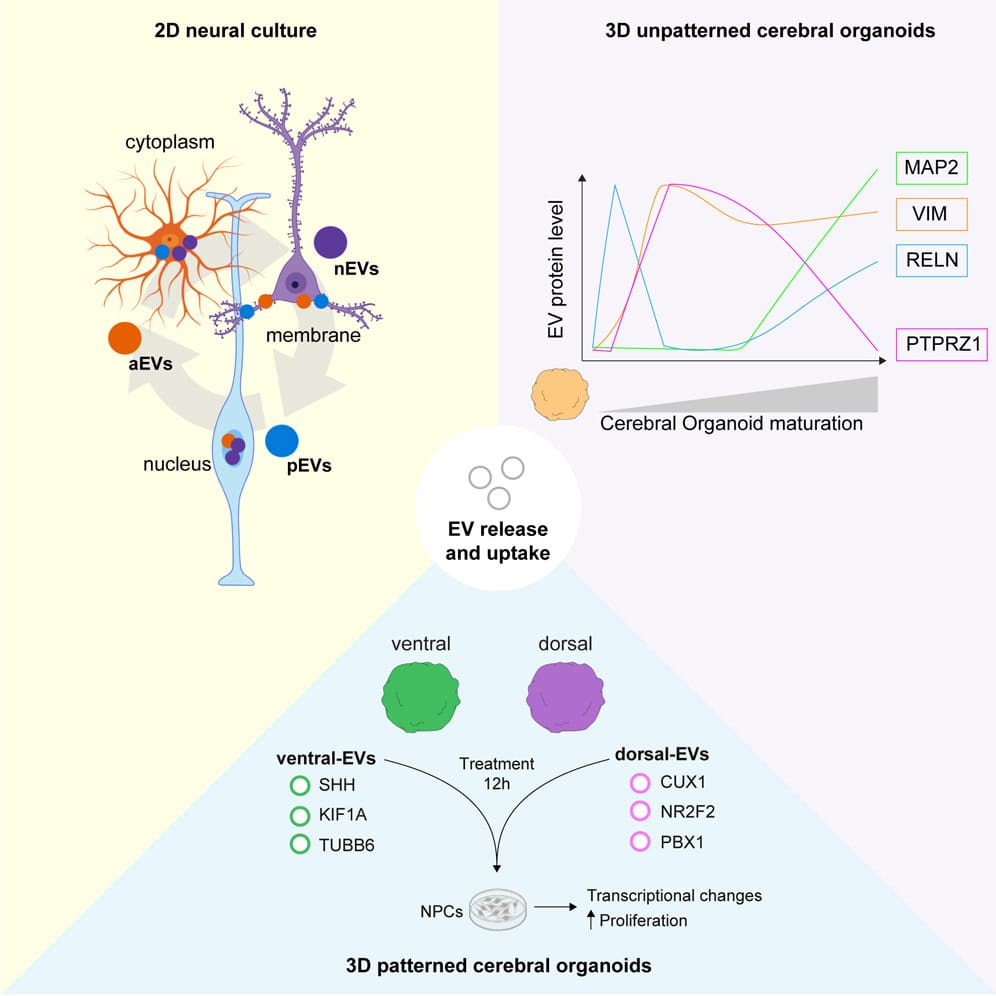
Graphical abstract. From Forero et al., 2024. “Extracellular vesicle-mediated trafficking of molecular cues during human brain development“, Cell Reports, Volume 43, Issue 10, 114755. Licensed under the terms of the Creative Commons CC-BY license.
Insights into extracellular vesicle (EV) protein composition and function during human brain development: Forero et al. investigated EV heterogeneity across different neural cell types and developmental stages, using both 2D neural cultures and 3D cerebral organoids.
The study, out of the Cappello lab, revealed that EV protein content varies significantly among neural progenitor cells, neurons, and astrocytes, with neurons exhibiting the most unique protein content.
Through proteomic analysis, they demonstrated that EV composition doesn’t strictly follow RNA expression patterns, suggesting regulated protein loading mechanisms. The research uncovered cell-type-specific EV uptake dynamics and identified novel nuclear trafficking mechanisms in neural progenitor cells during mitosis.
The study also revealed that transcription factors transported via EVs maintain their functionality in recipient cells, establishing EVs as crucial mediators of intercellular communication during brain development.
This research advances our understanding of EV-mediated cellular crosstalk in neurodevelopment and was facilitated by high-resolution LC-MS/MS analysis using an IonOpticks Aurora Ultimate 25×75 C18 UHPLC column, enabling detailed protein profiling of these complex biological samples.
Publication
Cell Reports
Authors
Andrea Forero, Fabrizia Pipicelli, Sylvain Moser, Natalia Baumann, Christian Grätz, Mariano Gonzalez Pisfil, Michael W. Pfaffl, Benno Pütz, Pavel Kielkowski, Filippo M. Cernilogar, Giuseppina Maccarrone, Rossella Di Giaimo, & Silvia Cappello
Title
Extracellular vesicle-mediated trafficking of molecular cues during human brain development